WhatsApp
ONLINE CONSULTING
Instagram

Implant Dental Treatment

Implant Dental Treatment

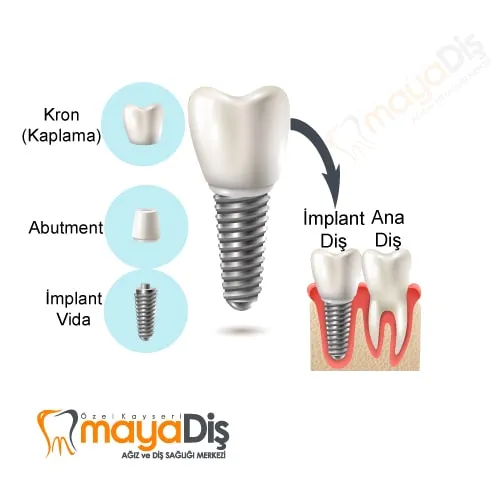
Implant; It is an artificial tooth root, mostly in the form of a screw, that is placed in the jawbone with a simple operation for functional and aesthetic purposes instead of missing teeth. Implants are made of titanium, and the jaw bone perceives titanium as a part of the body, ensuring high tissue compatibility and is a treatment method with a high success rate. It is widely used in dentistry because it can be applied to a wide range of patients, from single tooth deficiencies to patients with no teeth at all. This application is performed without any intervention to the adjacent teeth.

  • What is an implant? What does dental implant mean?
    Implant treatment is a method with a very high success rate, as is well documented in the scientific database. It provides a natural appearance to all patients with lost or missing teeth in the aesthetic field.
  • What substance/material is the implant made of?
    A dental implant is a material made of titanium material that is compatible with the body and is accepted by the body as if it were a part of the body.
  • How long does dental implant treatment take?

    For the implants to fuse with the bone (osteointegration) after they are placed, if advanced applications are not performed; Depending on the age, bone quality and systemic condition of the patient, a bone healing period ranging from 1 to 6 months is required.
    With the development of the surface properties of the implants used today, temporary implant-supported prostheses can be made. There are many factors that determine the timing of the prosthesis to be placed on the implant.
    This period is 1/4 less for the seamless implant. For a seamless implant, this time is between 6-9 minutes for each tooth.
    Your dentist will determine the correct timing of the treatment process, taking into account your expectations.
  • Who can receive dental implant treatment?
    It is applied to people who are in good general health, have a suitable jaw bone, have no teeth or have a single missing tooth.
  • Why is the first examination performed?
    For a successful implant treatment, surgical planning and treatment options must be evaluated based on a very clear prosthetic evaluation before the procedure.
    During the examination, panoramic radiography or three-dimensional images (tomography) of the teeth are taken and modeling procedures are performed. The type and brand to be applied are decided.
  • Can all dentists perform implants?
    If you want to get the best results; We recommend that you choose a dentist who is an expert in his field, has experience in this treatment, and has received the necessary training.
  • Are dental implants available for children?
    Yes, dental implants can be made for children. Children are at high risk of injury or accident because they are very active. Due to these risks, it may be possible to lose permanent teeth. In such cases, after children complete their growth and development Having this treatment will be a definitive and permanent solution.
  • Should patients using palatal (movable) prosthesis have implants?
    Yes. Patients who use palate prosthesis (completely edentulous) can get rid of removable dentures with implant treatment.
  • Will I remain toothless until the dentures are made?
    Your dentist will decide what type of temporary dental prosthesis will be applied depending on the number of your missing teeth. If you are missing a lot of teeth, you can get a temporary removable prosthesis or a fixed prosthesis depending on the method used.
    In case of no teeth or similar cases, in partial edentulism, Bredent Fast&Fixed technique It is possible to make a fixed temporary tooth with an implant in one day.
  • What is flapless (seamless) surgery on implants?
    The procedure is performed without damaging the gums surrounding the teeth, without stitching or cutting, and is called flapless (seamless implant) surgery. In this procedure, healing occurs very quickly and is more comfortable. Not every case may be suitable for this technique. Your dentist will make the decision on this issue at the end of the first examination.
  • What is the All On 4 and All On 6 technique (implant in one day)?
    All-on-4 or All-on-6 treatment is a new form of implant treatment using titanium screws in completely toothless jaws. The most important difference between All-on-4 or All-one-6 treatment from other treatments is the way the implants are positioned in the mouth and the temporary crowns are placed on the implant without the need for a waiting period of approximately 3 months. Immediate placement.
    Implants are placed at different angles according to the region where they will be positioned, ensuring full adhesion. While traditional implant treatment uses 8 to 10 implants in a jaw with no teeth, this technique only uses 4 or 6 implants. is placed. After the implants are placed, temporary crowns (coverings) or bridges are placed on the implants. After an average of 3 months, the treatment ends with the installation of permanent crowns (veneers). Maintenance of All on 4 or All on 6 implants is the same as traditional implants.
  • What are the types of implant-supported crowns (veneers)?
    • Cast Ceramic Coating on Implant (Smante)
    • Cast Ceramic Coating on Top of Implant (Screw System)
    • Eos Ceramic Coating on Top of Implant (Smante)
    • Eos Ceramic Coating on Top of Implant (Screw System)
    • Zirconium Coating on Top of Implant (Smante)
    • Zirconium Coating on Implant (Screw System)

  • How are dental implants made? Step by step dental implant treatment process
    • During the implant process, your physician will perform your first examination and perform the necessary tests. Your x-ray is taken with our state-of-the-art Tomography devices and it is evaluated whether the mouth-jaw structure and health are suitable for tissue and tooth transplantation treatment. In addition, necessary examinations may be requested, taking into account your general health condition.
    After it is determined that you are suitable for implant treatment, the areas where the implant will be placed are determined by your dentist through Tomographic data (3D Imaging).
    Your dentist will inform you in detail about which implant is suitable for your jaw structure, approximately how long the procedure will take, what to pay attention to before and after the surgery, and price information.
    The patient and the physician. If available, procedures can be started on the same day, otherwise an appointment will be made for a suitable date. Your implant placement surgery can be performed under local anesthesia or general anesthesia. You can decide together with your physician which method will be applied.
    • In case you have bone loss or bone deficiency due to gum diseases, the problematic area is brought to the desired density of bone tissue by bone grafting.

    • After your implants are placed with a simple operation, your physician will ask you to come for check-ups several times during the approximately 3-month waiting period until the bone heals.

    • At the end of the waiting period, your physician will make an appointment for the measurements and rehearsals of your implant-supported prostheses. Your treatment will end with the installation of your implant-supported dentures approved by you and your physician during rehearsals, at the last appointment.

    1. Stage - Placing an implant screw (artificial tooth root) in the jawbone:
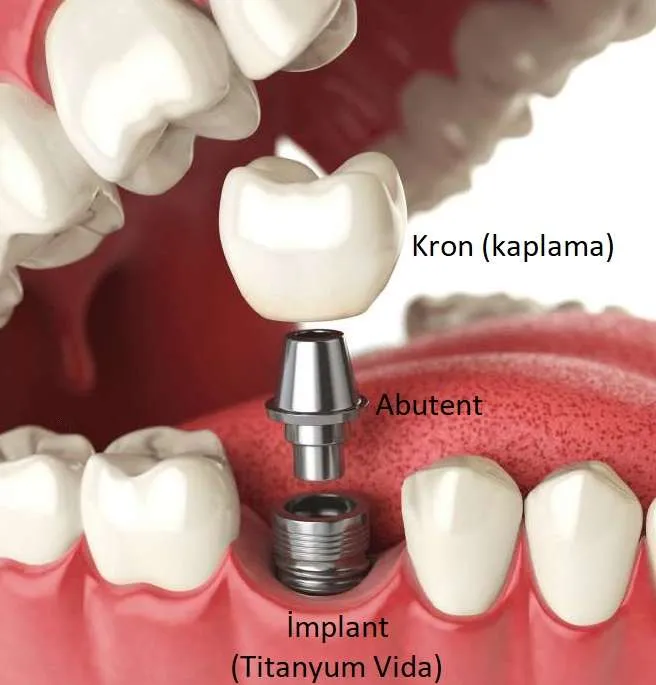
    First, a channel is opened on the area where the missing tooth is located in the jawbone under the gum tissue and implants are placed in these spaces. A connector, known as a dental abutment, is then placed over the dental implant to hold and support the on-implant ceramic crowns (veneers). During these procedures, the patient does not feel toothache or pain. In the implant placement process, the time required for one implant is approximately 30 minutes.
    2. Second stage - Installation of the crown (covering) on ​​the implant:
    After the first procedure and a waiting period of approximately 3 months, the implants are well seated and fused to the bone. During the waiting period, intraoral measurements are taken and implant-supported crowns (veneers) are prepared according to the patient's mouth structure and tooth positions. As the final process, crowns (veneers) are placed on the implants.
    Crowns (veneers) are manufactured - individually - with state-of-the-art devices in order to give you the most beautiful smile, and at the end of the rehearsals, the crowns (veneers) are given their final shape with your approval.
    To get detailed information. You can write on Whatsappor call immediately on 0352 220 3000
  • What are the advantages of implant dental treatment?
    Implant treatment method is revolutionary in the treatment of missing teeth with developing technology. The long-term success rate of implant treatment is 97 percent. The advantages of this method are as follows:
    • It provides an aesthetically very close appearance to the natural tooth. Thus, it is difficult to distinguish it from other teeth in terms of appearance and use.

    • It eliminates the necessity of dentures being mobile.
    • High quality implants can be used for a lifetime with good care.
    • Implant teeth perform the same function as natural teeth and do not cause difficulties in nutrition or dental care. It gives a normal chewing feeling.
    • Requires little maintenance. Just like your main teeth, it is easy to brush and care for your implanted teeth using dental floss.
    • It gives you a feeling of self-confidence and gives you an aesthetic smile.
    • During the procedures, neighboring teeth are not intervened and only the relevant tooth is performed.
    • In dental implants, there is no need for any other material or material to keep the dentures in place.
    • Basically, since the implant takes the burden of the dental prostheses like a real tooth root, it provides a much more natural, healthy chewing feeling. It provides speech and images. Therefore, implant dental treatment is the most appropriate treatment method to replace missing teeth.

  • Are there any side effects, risks, harms or disadvantages of implant treatment?
    It has not been medically determined to have any side effects. In scientific research, no negative clinical cases or allergic reactions have been encountered.
    However, after the implant screw is placed in the jawbone, the body will naturally react to that object. This reaction lasts between 7 and 10 days and returns to normal at the end of this period. There will be no reaction at later times.
  • If there is not enough bone in the place where the implant will be placed, what method is applied?
    The density, height and thickness of the bone in the area where the implant will be placed are important. This situation affects the success rate of the treatment. In cases where there is not enough bone, it is necessary to create bone with different techniques (using bone grafts) to bring the bone density to the desired level. For this procedure, procedures such as horizontal and vertical bone formation in the jaw, block grafting, and sinus lift procedures in the upper back area can be performed.
  • Will I feel toothache and pain during and after implant treatment?
    Surgical procedures are performed using local anesthesia, sedation or general anesthesia. During this procedure, the patient does not feel any pain or discomfort. The pain and aching sensation that may occur after the implant procedure is almost non-existent and disappears in a short time if you follow your dentist's advice and recommendations.
    Implant patients are generally able to do their daily activities the next day after the surgery.
  • Why do dental implant prices differ?
    Since many brands and types of implants are produced, prices vary accordingly.
  • How should dental implant care be done?
    Dental care is no different than the care you would give to your main teeth. In order for your implants to last long, regular brushing, flossing and routine dentist check-ups are sufficient.
  • Are there alternatives to implant dental treatment?

    Alternative treatments to implant treatment are bridges and removable (denture) teeth. However, these are known to be very uncomfortable treatments compared to implant dental treatment.
    1. Differences between bridge teeth and implant teeth (Comparison)


    Bridge Tooth Implant Teeth

    Jawbone It receives support from neighboring teeth. It is fixed to the jawbone and receives support from the jawbone.

    Status Neighboring teeth must also be reduced and included in the bridge. No action is required on adjacent teeth.

    Lifespan (Usage period) It usually has a lifespan of 7 to 10 years. (Although bridge prices are affordable; it needs to be replaced every 7 to 10 years.) It has a lifespan of more than 15+ years. (With good care, you can use it for a lifetime).

    Cost Implants are cheaper than teeth. Bridges are expensive compared to teeth.

    Surgical Situation There is no need for surgery. Requires surgical procedure.

    Construction Time A short period of time, like a week at most. Average 3 months.

    2. Differences between denture and implant teeth (Comparison)


    Dentures Implants

    Jawbone Bone loss may occur over time and cause further deterioration of facial structure. It stimulates and helps protect the jawbone to protect the facial structure.

    Support It sits on the gums, hurts, can slip and cause discomfort. It is fixed to the jawbone like main teeth, does not slip and does not cause discomfort.

    Lifespan (Usage period) It usually lasts between 7 and 15 years. It has a lifespan of more than 15+ years. (With good care, you can use it for a lifetime).

    Cost More affordable but generally less effective. Higher priced but more effective in the long run.

    Emotion It takes a long time to get used to and doesn't feel natural. You feel like main teeth.

    Appearance It may be noticeable if it becomes loose or causes discomfort. Supports your cheeks and lips. Provides a natural look.

    Maintenance It must be removed regularly for cleaning. Implants are fixed. You can use the brush and dental floss as if you were treating your main teeth.

    Speech Can interfere with speech. You may have difficulty speaking. It might come off. You won't have any problems speaking.

    Nutrition You should avoid some hard or sticky foods. It provides full chewing function.

    Surgical Situation There is no need for surgery. Requires surgical procedure.

  • Is dental implant reliable and how long does it last?
    Implant treatment is a reliable treatment preferred all over the world with high success and satisfaction rates for many years. You can use your implants for a lifetime with good dental care.
  • Why does the implant move or shake?
    • Improper construction of implant-supported dentures,
    • Impairment of the health of the jawbone and gums (patient's failure to comply with oral hygiene rules, systematic diseases that develop after the implant operation, etc.)
    • If patients (especially those using removable dentures) do not follow the recommendations for the use of the dentures, the implant may move or shake.